ROY ROGERS DOUBLE R BAR RANCH: HAPPY TRAILS AND COWBOY TALES LIVES ON
There was a time when cowboys ruled the day, or at least the airwaves, and the good guy always won. From Tom Mix in the early 1900s, to Clint Eastwood and Kurt Russell today, most of us have wanted to be a cowboy or cowgirl at one time or another. Many of us grew up knowing that among the cowboys of the cinema, Roy Rogers was king, and Dale Evans was his queen.
Like any respectable western royalty, Roy and Dale had a horse ranch. It wasn’t in the wilds of Montana, and not even in the prairies of South Dakota. Nope. Not even close. The Roy Rogers Double R Bar Ranch, built in 1920, was sittin’ regally along the banks of the Mojave River in the small Route-66 community of Oro Grande, just outside of Victorville, California, and a few miles from their home in Apple Valley. Roy died at the age of 86 after a life well-spent.
Roy owned the ranch until the day he died in 1998, and after Dale followed him a few years later, the ranch was owned by a succession of investors and such, including Ernesto Enriquez, the son of one of Roy’s horse trainers, Carlos. Still, the 67 acre ranch seemed to be lacking the drive and spirit that was present when Roy would ride the range on one of his many horses and, sometimes, even a Honda motorcycle, much to the dismay of the local sheriff (something about a pesky helmet law).
Okay, now some of you might not know about Roy Rogers. Don’t feel bad. It happens. So just in case ya’ don’t, let me tell ya’ about the King of the Cowboys. Roy started out as a fellow from Ohio by the name of Leonard Slye. He was born in 1911, and when he was about 20, he followed his sister to Lawndale, a town near the Pacific Ocean. By early 1931, with a few family businesses in decline, Leonard took up picking peaches for a time. This was during the Great Depression. See the Steinbeck film, “The Grapes of Wrath” to get a feel for what that was like.
Anyway, by about 1932, Leonard, with motivation from his sister, auditioned for a spot on a local radio show, even though shyness just about did him in. A local music group, “The Rocky Mountaineers” offered him a job. As they say in Hollywood, the rest is history. Even if Hollywood doesn’t say that, by August of 1931, Roy–I mean Leonard, was a member of the band.
After changing the name of the group to “The Sons of the Pioneers,” and changing his name to Roy Rogers, the cowboy genre would never be the same. Soon to become the King of the Cowboys, he starred in 88 feature films and, along with Dale Evans, had the long-running “Roy Rogers show” on television, from 1951 to 1957.
It might have been the syndicated re-runs of the Roy Rogers Show that caught the eye of a young Jim Heffel, growing up in Wilmington, just a few miles from Roy’s original California home in Lawndale. In any case, 10-year-old Jim saw a cowboy riding down a street in the famous western town of Jackson Hole, Wyoming, and knew what he had to do. Just like Willie Nelson sang in 1980, “My Heroes Have Always Been Cowboys.” And they still are.
About Roy Rogers
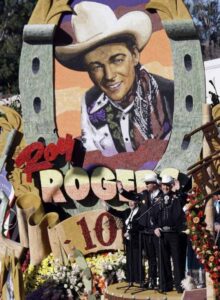
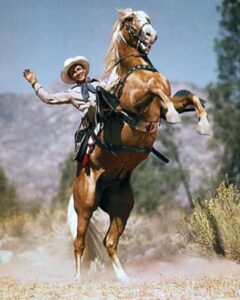
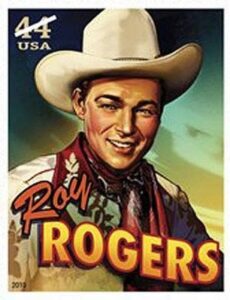
Roy Rogers (born Leonard Franklin Slye, November 5, 1911 – July 6, 1998) was an American singer, actor, and television host. Following early work under his given name, first as co-founder of the Sons of the Pioneers and then acting, the rebranded Rogers then became one of the most popular Western stars of his era. Known as the “King of the Cowboys”,he appeared in over 100 films and numerous radio and television episodes of The Roy Rogers Show. In many of his films and television episodes, he appeared with his wife, Dale Evans; his Golden Palomino, Trigger; and his German Shepherd, Bullet. His show was broadcast on radio for nine years and then on television from 1951 through 1957. His early roles were uncredited parts in films by fellow cowboy singing star Gene Autry and his productions usually featured a sidekick, often Pat Brady, Andy Devine, George “Gabby” Hayes, or Smiley Burnette. In his later years, he lent his name to the franchise chain of Roy Rogers Restaurants.
Roy Roger’s Music Career
After 19-year-old Len’s return to Lawndale, his sister Mary suggested that he audition for the Midnight Frolic radio program, which was broadcast over KMCS in Inglewood. A few nights later, wearing a Western shirt that Mary had made for him, he overcame his shyness and appeared on the program playing guitar, singing, and yodeling.[3] A few days later, he was asked to join a local country music group, the Rocky Mountaineers. He accepted the group’s offer and became a member in August 1931.
For a brief time in 1933, Lubbock, Texas, was headquarters for the O-Bar-O Cowboys. The Cowboys made little money performing at dances and small theaters in such places as Brownfield and Littlefield. The O-Bar-O Cowboys disbanded in Lubbock. Rogers and his associates Bob Nolan and Tim Spencer went on to organize the Sons of the Pioneers in 1934.[4]
By September 1931, Len hired the Canadian-born Bob Nolan, who answered the group’s classified ad in the Los Angeles Herald-Examiner that read, “Yodeler for old-time act, to travel. Tenor preferred.” Nolan stayed with the group only a short time, but Len and he stayed in touch. Nolan was replaced by Tim Spencer
In the spring of 1932, Len, Spencer, and another singer, Slumber Nichols, left the Rocky Mountaineers to form a trio, which soon failed. Throughout that year, Len and Spencer moved through a series of short-lived groups, including the International Cowboys and the O-Bar-O Cowboys. When Spencer left the O-Bar-O Cowboys to take a break from music, Len joined Jack LeFevre and His Texas Outlaws, who were a popular act on a local Los Angeles radio station.[7]
In early 1933, Len, Nolan, and Spencer formed the Pioneers Trio, with Slye on guitar, Nolan on string bass, and Spencer as lead vocalist. They rehearsed for weeks refining their vocal harmonies. During this time, Len continued to work with his radio singing group, while Spencer and Nolan began writing songs for the trio.[6] In early 1934, the fiddle player Hugh Farr joined the group, adding a bass voice to their vocal arrangements. Later that year, the Pioneers Trio became the Sons of the Pioneers when a radio station announcer changed their name because he felt they were too young to be pioneers. The name was received well and fit the group, which was no longer a trio.
By summer 1934, the popularity and fame of the Sons of the Pioneers extended beyond the Los Angeles area and quickly spread across the country through short syndicated radio segments that were later rebroadcast across the United States. The Sons of the Pioneers signed a recording contract with the newly founded Decca label and made their first commercial recording on August 8, 1934. One of the first songs recorded during that first session was “Tumbling Tumbleweeds“, written by Bob Nolan. Over the next two years, the Sons of the Pioneers recorded 32 songs for Decca, including the classic “Cool Water“.
Film Career
From his first film appearance in 1935, Len worked steadily in Western films, including a large supporting role as a singing cowboy while still billed as Leonard Slye in a Gene Autry movie. In 1938, Autry demanded more money for his work, and there was a competition for a new singing cowboy. Many singers sought the job, including Willie Phelps of the Phelps brothers, who appeared in early Western movies. Len ended up winning the contest and was given the stage name Roy Rogers by Republic Pictures, suggesting the western-sounding name Roy and combining it with the surname of the popular western comic entertainer Will Rogers. He was assigned the leading role in Under Western Stars. He became a matinee idol, a competitor with Autry as the nation’s favorite singing cowboy. In addition to his own movies, he played a supporting role in the John Wayne classic Dark Command (1940), which also featured one of his future sidekicks, George “Gabby” Hayes. He became a major box-office attraction. Unlike other stars, the vast majority of his leading roles allowed him to play a character with his own name, in the manner of Autry.

In the Motion Picture Herald Top Ten Money-Making Western Stars poll, Rogers was listed for 16 consecutive years, from 1939 to 1954, holding first place from 1943 to 1954 until the poll ceased. He appeared in the similar BoxOffice poll from 1938 to 1955, holding first place from 1943 to 1952. In the final three years of that poll, he was second only to Randolph Scott. These two polls are only an indication of the popularity of series stars, but Rogers also appeared in the Top Ten Money Making Stars Poll of all films in 1945 and 1946. Rogers was an idol for many children through his films and television shows. Most of his postwar films were in Trucolor during an era when almost all other B westerns were black and white. Some of his movies would segue into animal adventures, in which his horse, Trigger, would go off on his own for a while with the camera following him.
With money from Rogers’ films and from his public appearances going to Republic Pictures, he brought a clause into a 1940 contract with the studio where he would have the right to his likeness, voice, and name for merchandising. There were Roy Rogers action figures, cowboy adventure novels, and playsets, as well as a comic strip, a long-lived Dell Comics comic book series (Roy Rogers Comics) written by Gaylord Du Bois, and a variety of marketing successes. Rogers was second only to Walt Disney in the number of items featuring his name.
The Sons of the Pioneers continued their popularity and have not stopped performing from the time Rogers started the group, replacing members as they retired or died (all original members are dead). Although he was no longer an active member, they often appeared as his backup group in films, radio, and television, and he would occasionally appear with them in performances up until his death.
He met Dale Evans in 1944 when they were cast in a film together. They were well known as advocates for adoption and as founders and operators of children’s charities. They adopted several children. Both were outspoken Christians after their marriage. Beginning in 1949, they were part of the Hollywood Christian Group, founded by their friend, Louis Evans, Jr., the organizing pastor of Bel Air Church.The group met in Henrietta Mears’s home and later in the home of Evans and Colleen Townsend, after their marriage. Billy Graham and Jane Russell were also part of this group. In 1956, the Hollywood Christian Group became Bel Air Church. In Apple Valley, California, where they made their home, streets, highways, and civic buildings have been named after them in recognition of their efforts on behalf of homeless and handicapped children. Rogers was also an active Freemason and a Shriner and was noted for his support of their charities.

Rogers and Evans’ famous theme song, “Happy Trails“, was written by Evans; they sang it as a duet to sign off their television show. In fall 1962, they cohosted a comedy-Western-variety program, The Roy Rogers and Dale Evans Show, aired on ABC. It was cancelled after three months, losing in the ratings to The Jackie Gleason Show on CBS. He also made numerous cameo or guest appearances on other popular television shows, starring as himself or other cowboy-type characters, such as in an episode of Wonder Woman called “The Bushwackers“.[18] Rogers owned a Hollywood production company, which produced his own series. It also filmed other undertakings, including the 1955–1956 CBS Western series Brave Eagle, starring Keith Larsen as a young, peaceful Cheyenne chief, Kim Winona as Morning Star, his romantic interest, and the Hopi Indian Anthony Numkena as Keena, Brave Eagle’s foster son. In 1968, Rogers licensed his name to the Marriott Corporation, which converted its Hot Shoppes restaurants into Roy Rogers Restaurants, with which he otherwise had no involvement. Rogers owned a thoroughbred racehorse named Triggairo, that won 13 career races, including the 1975 El Encino Stakes at Santa Anita Park.[19] Rogers returned to Lubbock in 1970 to headline the Texas Tech University Intercollegiate Rodeo with Evans. In 1975, his last motion picture, Macintosh and T.J. was filmed at the 6666 Ranch in King County, 90 miles east of Lubbock and near the O- Bar-O Ranch in Kent County
Personal Life
In 1932, a palomino colt foaled in California was named “Golden Cloud”; when Rogers acquired him, he renamed him Trigger. In 1932, Rogers met an admirer named Lucile Ascolese. They were married in 1933 by a justice of the peace in Los Angeles; the marriage failed, and the couple divorced in 1936. Rogers then went on tour with the O-Bar-O Cowboys and in June 1933 met Grace Arline Wilkins at a Roswell, New Mexico radio station. They were married in Roswell on June 11, 1936, having corresponded since their first meeting. In 1941, the couple adopted a daughter, Cheryl Darlene. Two years later, Grace gave birth to daughter Linda Lou. A son, Roy, Jr. (“Dusty”), was born in 1946; Grace died of complications from the birth a few days later, on November 3.
Rogers met Dale Evans in 1944 when they were cast in a film together. They fell in love soon after Grace’s death, and Rogers proposed to her during a rodeo at Chicago Stadium. They married on New Year’s Eve in 1947 at the Flying L Ranch in Davis, Oklahoma, where they had filmed Home in Oklahoma a few months earlier. Together they had five children: Robin Elizabeth, who had Down syndrome and died of complications with mumps shortly before her second birthday; three adopted daughters, Mimi, Dodie, and Debbie; and one adopted son, Sandy. Evans wrote about the loss of their daughter Robin in her book Angel Unaware. Rogers and Evans remained married until his death.[21]
In 1955, Rogers and Evans purchased a 168-acre (68 ha) ranch near Chatsworth, California, complete with a hilltop ranch house expanding it to 300 acres (121 ha). After their adopted daughter Debbie was killed in a church bus accident in 1964, they moved to the 67-acre (27 ha) Double R Bar Ranch in Apple Valley, California, living in the nearby town.
Rogers was a Freemason and a member of Hollywood (California) Lodge No. 355, the Scottish Rite Valley of Los Angeles, and Al Malaikah Shrine Temple. He was also a pilot and the owner of a Cessna Bobcat.
Rogers supported Barry Goldwater in the 1964 United States presidential election.
Death
Rogers died of congestive heart failure on July 6, 1998, in Apple Valley, California. He was buried at Sunset Hills Memorial Park in Apple Valley, as was his wife Dale Evans three years later
Honors and Awards
On February 8, 1960, Rogers was honored with three stars on the Hollywood Walk of Fame: for Motion Pictures at 1752 Vine Street, for Television at 1620 Vine Street, and for Radio at 1733 Vine Street. In 1983 he was awarded the Golden Boot Award and in 1996 he received the Golden Boot Founder’s Award.
In 1967, Rogers, with Choctaw blood on his mother’s side, was named outstanding Indian citizen of the year by a group of Western tribes.
In 1976, Rogers and Evans were inducted into the Western Performers Hall of Fame at the National Cowboy & Western Heritage Museum in Oklahoma City, Oklahoma, and in 1995 he was inducted again as a founding member of the Sons of the Pioneers.
Rogers received recognition from the State of Arkansas, appointed by the governor of that state with an Arkansas Traveler certificate.[36]
Rogers was also twice elected to the Country Music Hall of Fame, first as a member of the Sons of the Pioneers in 1980, and again as a soloist in 1988. As of July 2013, he was the only person elected to the Country Music Hall of Fame twice. In 2001, a Golden Palm Star on the Palm Springs, California, Walk of Stars was dedicated to him and Dale Evans.
Rogers’ cultural influence is reflected in numerous songs, including “If I Had a Boat” by Lyle Lovett, “Roy Rogers” by Elton John on his 1973 album Goodbye Yellow Brick Road, and “Should’ve Been a Cowboy” by Toby Keith. Rogers himself makes an appearance in the music video for the song “Heroes and Friends” by Randy Travis. Rogers is referenced in numerous films, including Die Hard (1988) in which the Bruce Willis character John McClane used the pseudonym “Roy” and remarks, “I was always kinda partial to Roy Rogers actually.” In the television series American Dad!, the character Roger uses “Roy Rogers” as a pseudonym in the episode “Roy Rogers McFreely“. In the movie City Slickers, the Jack Palance character Curly, sings the song “Tumbling Tumbleweeds” while the Billy Crystal character Mitch is playing the harmonica.